Preservation Conference June 24, 2022
Prairie City Cemetery Historical Register Application Info
Tour and Information presented by:
Marta Jardon and John Jackson, Prairie City Cemetery Association
Contact us at: prairiecity.cem@gmail.com


Describe the organization and features of the cemetery.
The Prairie City Cemetery (PCC) is a square piece of land, 295 feet from east to west, and 295 feet from north to south. It is bordered by E. 1600 Rd on the east, separated from the road by a grass easement with no fence or wall. A cow pasture borders the north and west and is separated from the cemetery by a wire fence. The Mt. Calvary Catholic Cemetery (MCC), established 1867, borders PCC to the south and is separated from PCC by a shared gravel driveway. The two cemeteries date back to the early days of Territorial Kansas and were established in the town of Prairie City. The cemeteries share an entryway and a driveway, but otherwise operate as separate entities. PCC is not affiliated with, nor supported by, any institution – religious, public, or otherwise. It is owned and managed by the Prairie City Cemetery Association. Interestingly, both cemeteries are cared for by descendants of original Prairie City families.
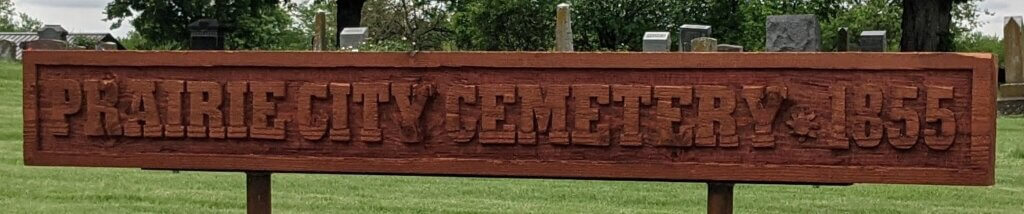
PCC has a gravel driveway along the south, west, and north sides. (See “Bird’s-eye View on last page.) This driveway is used by visitors to both cemeteries. A stone gateway marked “Prairie City Cemetery” is located in the SE corner of the PCC property, at the main entrance to the cemeteries. (MCC has a matching gateway on their side of the entrance, marked “Mt. Calvary Cemetery.” Both gateways were provided by the same donors in 1959.) No buildings exist on the PCC property, although the MCC kindly provides a spot in their pavilion on their property for the posting of PCC information.
The cemetery itself was platted much like a town. It consists of Blocks which are subdivided into Sections, and the Sections are further subdivided into Lots (or plots). Four feet wide walkways were planned between each Block. The cemetery contains a total of 49 Blocks.
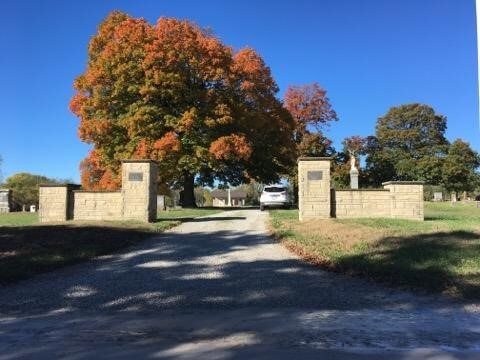
to Prairie City (on right)
and Mt. Calvary (on left) Catholic Cemeteries
How was the cemetery established?
The land for Prairie City Cemetery “was set aside by the government to be used as a cemetery at the time Prairie City was organized in 1855.”
Who did this cemetery serve?
Prairie City Cemetery (PCC) has been open to the general public since 1855. PCC initially served the people who settled in and around the town of Prairie City, Kansas Territory. In the later 1800s, as Prairie City became adjacent to Baldwin City, the cemetery continued to serve the surrounding communities. Veterans of every war (including the War of 1812) are buried here.
Who has owned and maintained the cemetery over time?
The Prairie City Cemetery Association, or PCCA, (originally called the Prairie City Cemetery Company) owns, controls, and manages the cemetery, and has since 1879. We believe that the City of Prairie City maintained the cemetery prior to the city’s dissolution, but early cemetery records have been destroyed. We continue to research this area.
Are there any cemetery records? Where are they held?
Partial cemetery records exist. Unfortunately, a fire in the 1930s destroyed the early records. The records that do exist are kept mainly in the care of the President of the Prairie City Cemetery Association, John Jackson, with the rest in the care of the Association’s Treasurer, Marta Jardon. (Both live in Baldwin City, not far from the cemetery!) The Baldwin City Public Library also has information about this cemetery.
Why is this property historically or architecturally significant?
Prairie City Cemetery (PCC) was established in 1855. We are still caring for those past citizens of Prairie City, Baldwin City, the West Baldwin community, and other local communities. The cemetery is still active and continues to care for local citizens these many decades later.
Historical Significance:
PCC is historically significant for several reasons. Having been established in 1855, with its first burial in 1856, it is representative of the town cemeteries established by Territorial towns in Kansas. As such it contains the remains of many historically important persons such as Territorial settlers, early Kansas pioneers, as well as the leaders, builders, and citizens of the town of Prairie City, and early Douglas and Franklin counties. Many of the interred were involved in the fight to establish Kansas as a Free State as they served in the Kansas Militia in 1864, fighting Major General Sterling Price during the Battle of Westport. These Militia members assisted in preventing Missouri from being recovered by the Confederacy. At least one protected Lawrence from Border Ruffians during several conflicts there before and during the early Civil War. Union Civil War veterans, representing several states, are also buried here, as well as those who cared for their families at home as the men were off fighting.
The 1856 establishment of Baker University (BU), and the building of its campus are also historically significant to the area and to Kansas. The still-growing town of Baldwin City was essentially formed because of Baker. Several of those buried in PCC actually built the buildings at BU and in Baldwin (Miller, Burkett). Others were the architects (Spurgeon), surveyors (Elias), produced the supplies (Ashby), or had other roles – all important to creating these lasting institutions that have served many for generations.
Architectural Significance:
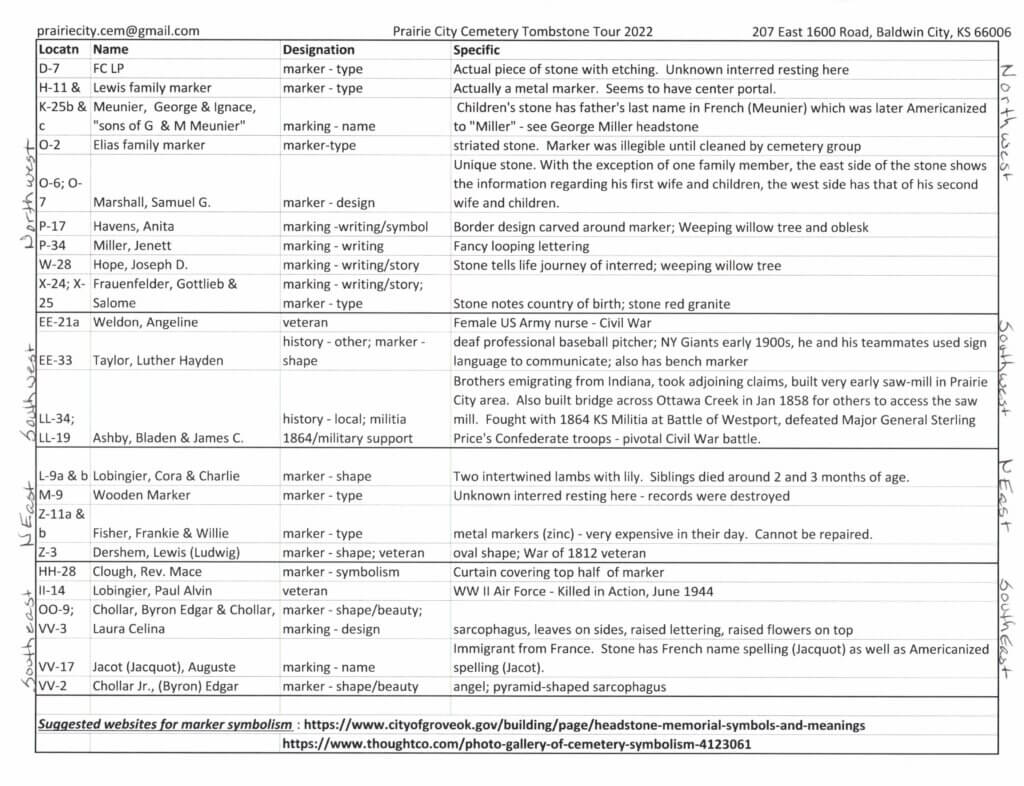
Refer to Tombstone Tour 2022 – page 6.
Provide a list of sources that document the historical significance of the property.
- “Prairie City and John Brown” by George and Ethel Butell, 1971, “Where Was Prairie City?” by George and Ethel Butell, 1972, booklets published by SFTHS of Douglas County
- Cemetery records, PCCA obituary and biography files
- Military & Census Records
- Plat Maps of Douglas County (1857, 1873) and Franklin County (1878)
- Freemen’s Champion newspaper – printed in Prairie City from June 1857 to Sept. 1858
- Kansas State Historical Society articles and records
Why is Register Listing being sought?
Register Listing for PCC is being sought as part of a larger plan to preserve and share the history of the town and people of Prairie City. Prairie City is not well known locally, nor it appears, at the state level. Its contributions to the Baldwin community are greatly overshadowed by those of the Palmyra community which was also established in 1855 several miles to the northeast. Prairie City brought the railroad to the area, which contributed much to the growth of Baldwin. Many members of the Prairie City community also became leaders and successful business owners in the town of Baldwin City.
As the last of the third and fourth generations of the long-time Prairie City-area families leave us, it becomes imperative that we document and share the important history of this area now. Having PCC added to the Register would be the first big step in calling attention to the cemetery and the people of Prairie City; thus, generating interest in learning about our forefathers, pioneers, and veterans.
As noted above, PCC is cared for by the Prairie City Cemetery Association (PCCA), and some things we cannot do ourselves. We have many very old tombstones and metal markers which need refurbishing, repair, and repositioning and require the care and/or guidance of experts. We are hopeful that a Register Listing, or consideration, might help us generate volunteer interest and raise funds in assisting us with this care. We are hoping to show honor and respect to those resting here by finding a way to complete this part of the project.

Map from booklet “Where Was Prairie City?”
by George and Ethel Butell, 1972
One Contribution of Prairie City to the Baldwin Area
Prairie City was established in 1855 by James Lane, Dr. William Graham, Louis Green, and Salmon S. Prouty. These men lobbied to have the railroad and depot come to Prairie City. After being delayed by the Civil War, the Leavenworth, Lawrence, and Galveston Railroad began operation in 1868, running almost through the center of the town. By the 1870s, the nearby growing town of Baldwin City had established a depot about a mile north of the depot in Prairie City. The railroad decided that these stops were too close together, so built a new depot about halfway between the two just west of the Baldwin City limits. The area around the new depot was called “Media”. In 1878 the post office was moved from Prairie City to Media. Many of the remaining Prairie City businesses moved as well. In 1883 the townsite was vacated, and Prairie City became a ghost town, just southwest of the Baldwin City limits.
— Marta Jardon, June 2022, Prairie City Cemetery Association

2022 Tombstone Tour Info is located below (QR code as well). The tour features some architecturally significant markers and historical figures in the cemetery, organized by quadrant. The approximate quadrants are marked by dashed lines above.