Black Jack Ruts, Ivan L. Boyd Memorial Prairie Preserve, and Black Jack Cabin
In Brief:
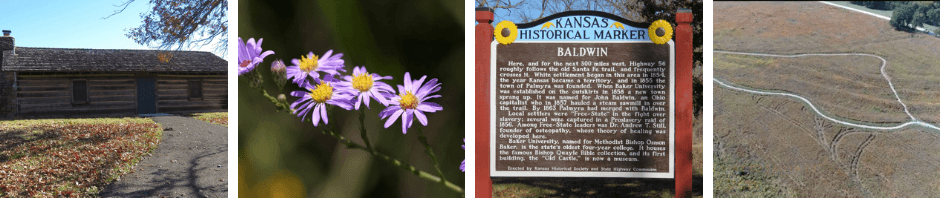
- Has two large historical markers – describe the Battle of Black Jack which occurred ½ mile to the south and history of Baldwin which is 3 miles further west on US 56.
- Stone marker was originally placed by Daughters of the American Revolution at the Black Jack Townsite ½ mile to the east.
- Green metal sign describes the 18 acres of native prairie to the south. Contains five very impressive tracks, five more obscure tracks, all left by the Santa Fe Trail between 1821 and the 1870’s.
- New gravel foot trail to the south goes out to ruts.
R. Boyd – 2020
- Historical log cabin built at park and opened in 1971.
- Cabin built in the style of cabins used in pioneer days.
M. Jardon – 7/2021
Photos/Images: Click HERE to view
More Information:
BLACK JACK PARK: Black Jack is a 3 ½ acre tract purchased by the State of Kansas and developed into one of the early roadside parks.1 It is located south of US 56, east of N. 2000 Rd. in Douglas County, KS. It was established on Sept. 26, 1940.
Formed by Local People: The original idea for a park began with local farmers and citizens from the Black Jack, Wellsville and Baldwin areas. The group was interested in creating a Memorial Park between the old Black Jack town site and the Battle of Black Jack site. Russell Hays offered 3 ½ acres of ground in this area on behalf of the Hays family. The group conferred with the State Highway Department and received approval of their idea. Some of the people involved in this process included: Ralph O’Neill, Fannie Cavender, Russell Hays, Floyd Kalb, Elizabeth Pearson, C.C. Waters, Henry Bell, H.L. O’Neill, C.E. Beeks, and Asa F. Converse.
Historical Markers: Currently three markers stand in the circle drive of the park. One contains information about the Battle of Black Jack, considered by many to be the first battle of the Civil of War. This battle occurred in 1856, ½ mile to the south of US 56. Another historical marker has the history of Baldwin, which is located three miles to the west. This marker was recently relocated from the north side of US 56. Both markers were repainted by SFTHS volunteers in 2020.
The red granite marker (DAR marker #8) that was placed by the Daughters of the American Revolution is also here. It was originally placed near the site of the town of Black Jack, which was located ½ mile to the east. In 1938 when US 50 (now 56) was widened and paved, the marker was moved to a grove of oak trees owned by Russell Hays adjacent to ruts.3 And here it remains.
IVAN L. BOYD MEMORIAL PRAIRIE PRESERVE: This Prairie Preserve is an 18 acre tract of land that was purchased in October 1967 from Russell Hayes by Douglas County. Its purpose is to preserve the prairie and the Santa Fe Trail (SFT) ruts made by traffic and erosion.4 The Hays family had long protected this historic area. Now the County would ensure that care continued.
Dr. Ivan L. Boyd was instrumental in the creation of this park. He helped preserve and further establish the stand of native grass. He used this prairie area in his teachings with his students at Baker University for many years. After his untimely death in 1982, the county commission voted to name the area after him due to his long-time commitment to acquiring and protecting the prairie and the wagon ruts.5
Originally, access to the ruts and prairie was across a small foot bridge. In 2020-21, an ADA-accessible path to the ruts and a gravel walking trail around them was installed by the Santa Fe Trail Historical Society of Douglas County. (See Black Jack Ruts Walking Trail story) (See Making the Walking Trail story in pictures)
The Prairie: The native prairie here is tall grass prairie. Less than 1% of it occurs in the U.S.; most is found in eastern Kansas. The roots from the prairie grasses may extend 30 feet down below the soil. This depth enables them to survive droughts and fires. Over 230 species of plants were documented by Dr. Roger Boyd (son of Dr. Ivan Boyd) on the prairie and park during his tenure at Baker University.6
Not Real Sibley Marker: By 1825, trade along the Trail had grown large and Congress commissioned a team of engineers to survey and map the Trail. They also authorized the making of treaties with the Indians for safe travel along the Trail. President James Monroe authorized the survey on March 3, 1825. The commissioners appointed to the survey were: Benjamin Reeves, Thomas Adams, and George Sibley. The surveyors were Joseph C. Brown and Archibald Gamble. They surveyed the entire route using rod and chain. They drew the first detailed map of the Trail from Fort Osage (MO) to Toas (NM). This survey is commonly called the “Sibley Survey.”7
A stone marker at the eastern edge of the walking trail by the ruts on the Boyd Prairie reads “Grindstone Creek, 40 rods, Sibley Survey, 1825.” While it would be exciting to think that Sibley and company left this marker here, he actually did not. It was placed here in 1965 by Russell Hays, owner of the land.8 (Editor’s Note: Research regarding the creek at this location and the location of Grindstone Creek is ongoing.)
BLACK JACK HISTORICAL LOG CABIN: In 1967, the park, currently known as the Ivan L. Boyd Memorial Prairie Preserve, was created. This county park was originally known as Prairie Park.9
SFTHS Forms: Also in 1967, the Santa Fe Trail Historical Society of Douglas County (SFTHS) was first formed, with Wilson Counts as president. Their goal was to preserve history as well as to educate others about local history and the Trail. So, the group decided to build a log structure in the style of cabins built in pioneer days.10 The structure would also be used as meeting place for community.
Designing the Cabin: “Wilson Counts drew up the specifications for the cabin.”11 “He and Bill Hey, Sr. researched the best design to be used for the corners where the logs joined. The design of the logs is important because it determines how water is shed.”12 “Each log had to be measured precisely and its place in the structure planned long before actual construction began.”13
Building the Cabin: “[Native] White oak trees from the Harry Yukon property just west of the Douglas County State Lake were used to build the cabin. Jack Sartin delivered the logs to Hey Machinery Company. Will Hey, Sr. sawed the logs at his sawmill west of Baldwin. Tom Swan of the Baldwin Lumber Yard provided a truck for the hauling of the lumber to the site. Harry North built the foundation. Drains were laid under the floor to insure a more lasting base. The Lawrence Construction Company accepted the challenge of building the log cabin. Harvey Booth and his tractor lifted the logs into place. Iron rods were used instead of wooden pegs to hold the logs together. A shake roof was added.”14
“Joe Ed Taul donated the rock for the fireplace from an old stone fence. Ed Rockhold built the stone fireplace. To make the room more comfortable, a steel lined Heatalator was added to the fireplace. Electric ceiling heaters were installed at a later date so that the cabin would be more useable during the winter months.”15
Others involved in work on the cabin included: Harvey Booth, Paul Selzer, Roger Martin.16
Completion of the Cabin: “On January 24, 1971, the cabin was opened for use. The building was dedicated to the memory of Dayton Van Tries and Harvey Booth, both of whom died before the building was finished. Various people have given and loaned articles of pioneer days to the cabin. Many tools came from the estate of Tecumseh Howard.”17
Memorial tapes were made at the time. One told of the Battle of Black Jack, written by Ruth Van Tries. The other told of the SFT, written by Helen Booth. Both were narrated by Senator Arden Booth (brother of Harvey).18 The tapes could be played by visitors by pushing a button located on the outside of the cabin.19 Currently, this feature is no longer in use.
The original flagpole at the northwest corner of cabin was from the schoolhouse in the town of Black Jack.20 Only the stub of the metal pole remains now. A new flagpole is in its place.21
M. Jardon – 7/2021
Notes
- Kelley, Katherine, Along the Santa Fe Trail in Douglas County, Kansas – A Brief History of The Seven D.A.R. Marker Sites and Town Sites Along the Route of the Trail in Douglas County (booklet), 1987, Santa Fe Trail Historical Society of Douglas County Archives, Baldwin City, Kansas, 9.
- Jackson, Dorthea, “Black Jack Park,” in A Brief History of Sites in the Black Jack Area in Douglas County, Kansas, 1999, Santa Fe Trail Historical Society of Douglas County Archives, Baldwin City, Kansas.
- Kelley, Along the Santa Fe Trail, 9.
- Jackson, Dorthea, “The Ivan Boyd Memorial Prairie Preserve,” in A Brief History of Sites in the Black Jack Area in Douglas County, Kansas.
- Boyd, Dr. Roger L., President, SFTHS Douglas County, email communication, 7/2021.
- Ibid.
- Jackson, Dorthea, “The Ivan Boyd Memorial Prairie Preserve,” in A Brief History of Sites in the Black Jack Area in Douglas County, Kansas.
- Ibid.
- Van Tries, Ruth, “A Brief History of the Log Building Located East of Baldwin City on Highway 56” in Black Jack: A Collection of Stories of Early Black Jack (booklet), Vol. 2, No. 3., (Baldwin City KS: Santa Fe Trail Historical Society of Douglas County,1980, unnumbered; between pages 10 and 11.
- Kelley, Along the Santa Fe Trail, 9.
- Van Tries, Ruth, “A Brief History of the Log Building” in Black Jack.
- Jackson, Dorthea, “The Black Jack Cabin,” in A Brief History of Sites in the Black Jack Area in Douglas County, Kansas.
- –, “Dedication of Black Jack Cabin Sunday, Jan. 24.” The Baldwin Ledger. January 21, 1971.
- Van Tries, Ruth, “A Brief History of the Log Building” in Black Jack.
- Ibid.
- Ibid.
- Ibid.
- –, “Dedication of Black Jack Cabin Sunday, Jan. 24.” The Baldwin Ledger. January 21, 1971.
- –, “200 Attend Dedication Sunday.” The Baldwin Ledger. January 27, 1971.
- Kelley, Along the Santa Fe Trail, 9.
- John Jackson, (local historian), personal interview with author, June 2, 2021
Sources
Jackson, Dorthea, A Brief History of Sites in the Black Jack Area in Douglas County, Kansas (essay collection), 1999, Santa Fe Trail Historical Society of Douglas County Archives, Baldwin City, Kansas.
Kelley, Katherine, Along the Santa Fe Trail in Douglas County, Kansas – A Brief History of The Seven D.A.R. Marker Sites and Town Sites Along the Route of the Trail in Douglas County (booklet), Baldwin City KS: Santa Fe Trail Historical Society of Douglas County, 1987.
Van Tries, Ruth, Black Jack: A Collection of Stories of Early Black Jack (booklet), Vol. 2, No. 3, Baldwin City KS: Santa Fe Trail Historical Society of Douglas County, 1980.
–, “Dedication of Black Jack Cabin Sunday, Jan. 24.” The Baldwin Ledger. January 21, 1971.
–, “200 Attend Dedication Sunday.” The Baldwin Ledger. January 27, 1971.